How Rural Internet, CTV, FAST and OTT Powered Growth from 2025 to 2026
Pick up your phone and an ad will find you within seconds. Switch on a smart TV and another one appears. This is more than a feeling. Between 2025 and 2026, India’s advertising money moved online faster than ever before.
So what is behind this growth? In this article, we look at the size of the shift, the rural internet boom that fuelled it, and the three screens now pulling in advertisers: Connected TV (CTV), Free Ad-Supported TV (FAST) and OTT streaming. We have also added five simple graphs so you can see the story at a glance.
Digital is now the biggest slice of the pie
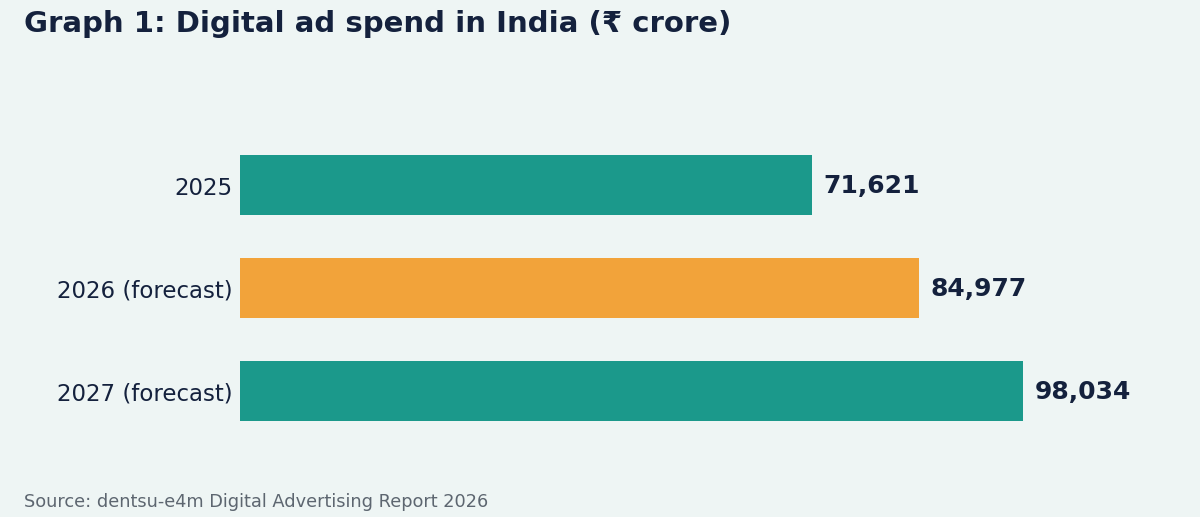
India’s total advertising industry closed 2025 at ₹1,21,339 crore, according to the dentsu-e4m Digital Advertising Report 2026. It is expected to reach ₹1,30,416 crore by the end of 2026. Inside this total, digital is the star. Digital advertising closed 2025 at ₹71,621 crore and is projected to touch ₹84,977 crore in 2026, a jump of 18.6%.
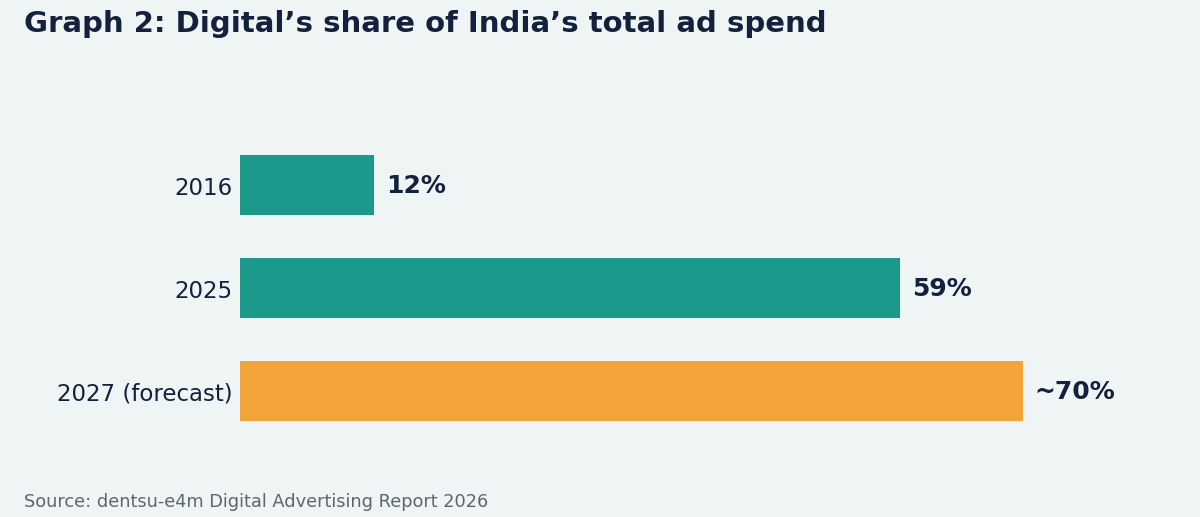
Think about how far digital has come. In 2016, it held just 12% of all ad spending. By the end of 2025, that had grown to about 59%. The same report expects nearly 70% by 2027, while television’s share slips from 21% to 15%.
Other forecasts agree on the direction. The Pitch Madison Advertising Report says digital’s share will rise from 60% in 2025 to 64% in 2026, and calls digital the only true growth engine. WPP Media’s forecast puts digital at 68.1% of ad revenue in 2026. The numbers differ because each firm counts the market in its own way, but the message is the same.
Inside digital, social media takes the largest share at 29%, followed by online video at 28%, paid search at 23% and display at 16%. Dentsu expects online video to grow 22.3% in 2026 and overtake social media by 2027. Automated ad buying, known as programmatic, already made up 42% of digital spending in 2025. Another fast riser is commerce media, which means ads on shopping platforms. WPP Media expects it to reach about ₹34,700 crore in 2026, up 29%. Sensor Tower adds that India’s app-based digital ad market crossed US$4 billion in 2025 and should pass US$5 billion in 2026.
Rural India is the new growth engine
Advertising follows attention, and attention follows the internet. The IAMAI–Kantar “Internet in India 2025” report says India now has about 958 million active internet users, up 8% in a year.
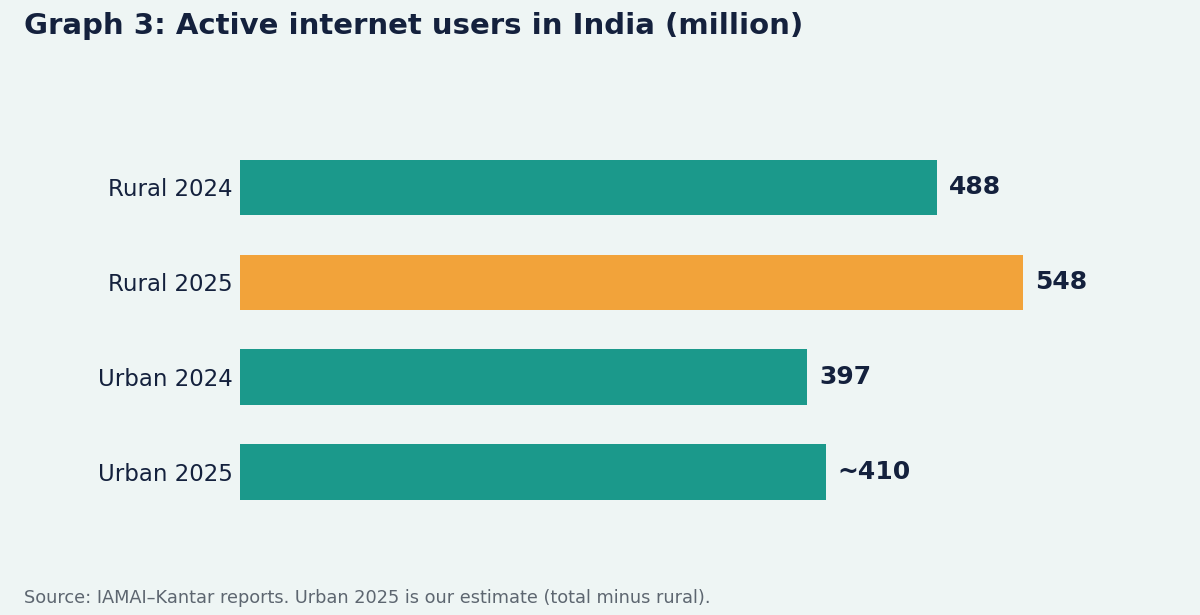
The big story is rural India. It now has around 548 million active users, which is 57% of the total, and it is growing almost four times faster than urban India. A year earlier, the report counted 488 million rural users against 397 million urban users. By our estimate, urban India now stands at roughly 410 million.
Why does this matter to brands? Because millions of new buyers are now reachable online, and most of them love video. In 2025, 588 million people, or 61% of all users, watched short videos, and rural users slightly outnumbered urban ones. Earlier IAMAI data also showed that rural users lean towards entertainment and communication, while urban users do more with money and shopping. In cities, 230 million people, or 56% of urban users, shopped online in 2025. That helps explain why e-commerce advertisers raised their digital spending by 56% in 2025, the fastest rise of any category in the dentsu-e4m report.
There is one catch. Many rural users share a device, and the number of rural shared-device users grew 24% since 2024. So ads must be light, mobile-friendly and in local languages to work well. Gaps remain between states too. Kerala, Goa and Maharashtra lead in internet use, while Uttar Pradesh, Jharkhand and Bihar are still behind. That means there is plenty of room left to grow.
CTV: the big screen joins the digital party
For years, digital advertising meant the phone screen. Now the television at home is joining in. CTV simply means a TV connected to the internet, such as a smart TV or a TV with a streaming stick. A new WPP Media and The Trade Desk report, prepared with Ormax Media, says India has 62 to 65 million CTV households and 207 million CTV viewers. That is three times the 2022 audience, and people watch about 2.9 hours a day. Gen Z watches even more, at 3.1 hours a day, and 77% of them watch with friends or family.
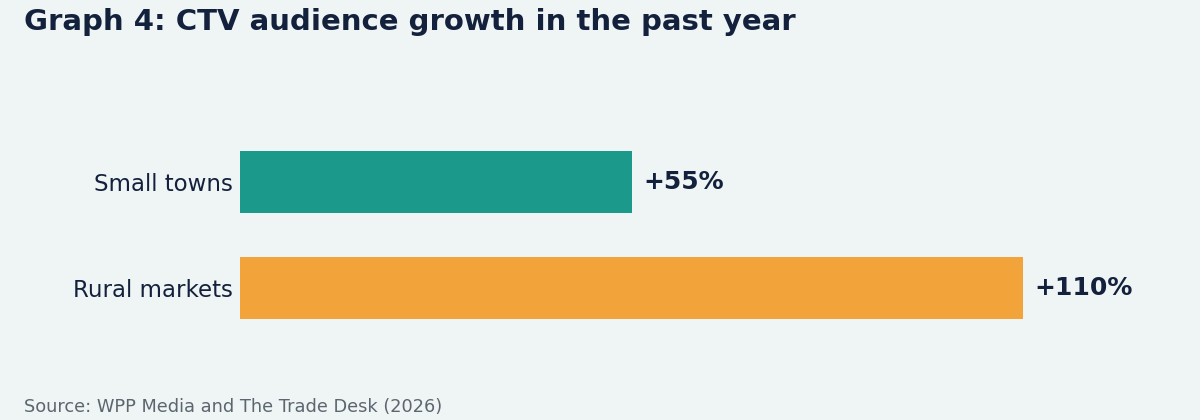
The surprise is where the growth is coming from. Over the past year, CTV audiences grew 55% in small towns and 110% in rural markets.
Advertisers like CTV for good reasons. About 32% of CTV viewers are cord-cutters or have never used regular TV, so a traditional TV plan cannot reach them. More than 80% of CTV viewing is shared, and one ad impression reaches about 2.5 people at home. And 83% of viewers look for more information after seeing an ad. During the FIFA World Cup 2026, CTV carried 52% more brands than linear TV, according to TAM Sports. Simply put, CTV mixes the emotional power of TV with the targeting and measurement of digital.
FAST: free TV that advertisers love
FAST stands for Free Ad-Supported Streaming Television. Think of it as TV channels that arrive over the internet, free of cost, with ads in between. These channels sit inside smart TV systems from brands like Samsung, LG, Xiaomi, Sony and TCL, so viewers do not need to download an app or pay a subscription.
The early numbers are promising. One in five CTV viewers already watches FAST, for close to 50 minutes a day, and one-third are aware of it. FAST viewers also spend 3.4 hours a day on CTV, compared with 2.9 hours for all CTV viewers. News, movies, reality shows and serials are the most-watched content.
The report describes FAST as the largest untapped pool of ad space in Indian CTV. Today it is urban-led, with the highest viewing in Delhi, Mumbai, Andhra Pradesh–Telangana and Tamil Nadu, which means there is room to grow. Late nights and weekends, especially 10 pm to midnight, are also high-attention but under-bought, so brands can find less crowded slots.
OTT: a giant audience, and ads are catching up
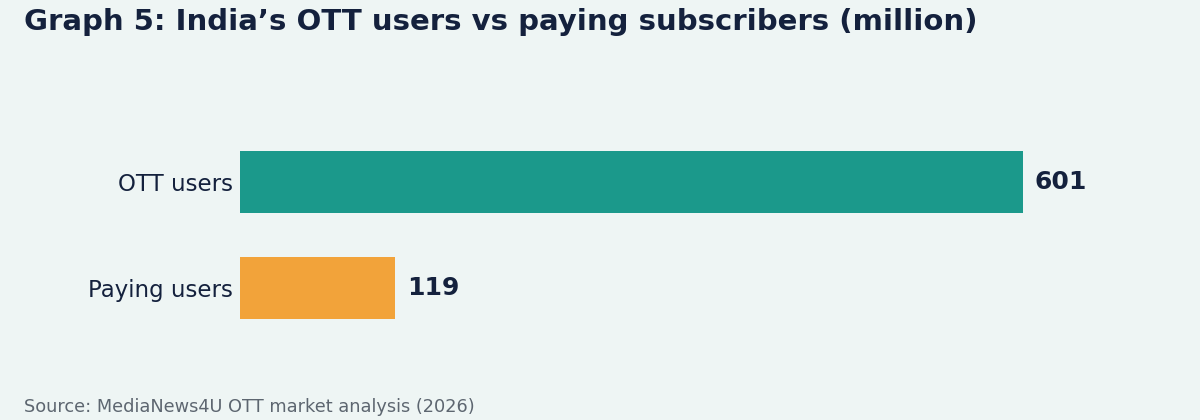
OTT platforms deliver video over the internet, from JioHotstar and Netflix to YouTube and Prime Video. India has about 601 million OTT users, but only around 119 million of them pay for a subscription. In other words, Indians watch a lot of video, but not everyone wants to pay for it.
This gap is good news for advertisers. India’s ad-supported video-on-demand market is forecast to grow from about US$2.4 billion in 2026 to US$4.5 billion by 2030, rising 16–18% a year. That is faster than subscription video, at 13.4%. Many streamers now offer cheaper plans with ads, and live sport pulls in huge crowds. Reports on JioStar’s April–June quarter said the IPL, subscriptions and CTV earnings helped lift revenue as advertisers shifted to digital.
Together, OTT and short video explain why online video is set to become digital’s biggest format.
Challenges to keep in mind
The growth story is strong, but it is not smooth. WPP Media’s midyear update trimmed its 2026 forecast to 8.8% growth for India’s total ad market. It warned about energy disruption linked to the Iran conflict, imported inflation and currency pressure, and it expects total TV advertising to fall 6.8% this year. Within digital, measurement is the big question for CTV. Advertisers want clearer data on frequency, transparency and real business results. Some broadcasters have also raised concerns that certain FAST channels may not follow programme and advertising codes. Brands should watch these issues closely.
What this means for your brand
Whether you run a large company or a small business, the lessons are simple:
- Think video first. Short videos and online video are where attention is growing.
- Go local. Use regional languages to reach rural and small-town audiences.
- Mix your screens. Use mobile for reach and CTV for impact at home.
- Try FAST early. Ad space is still less crowded.
- Measure outcomes. Track enquiries and sales, not just views.
The bottom line
From 2025 to 2026, digital advertising in India grew because people moved online, and brands followed them. Rural India brought hundreds of millions of users. CTV and FAST brought the big screen into the picture. OTT brought huge audiences that advertisers can reach without a subscription barrier. Digital is on course to hold close to two-thirds of ad spending this year and nearly 70% by 2027. The brands that understand these screens early will be the ones that grow with them.
Note: Figures come from industry reports published between January and October 2026. Numbers marked “forecast” are projections and may change. Different agencies measure the ad market differently, so totals and shares vary between reports.
ManziNetworks Media runs CTV, FAST, OTT and digital campaigns for brands across India, the GCC and South East Asia, since 2009.