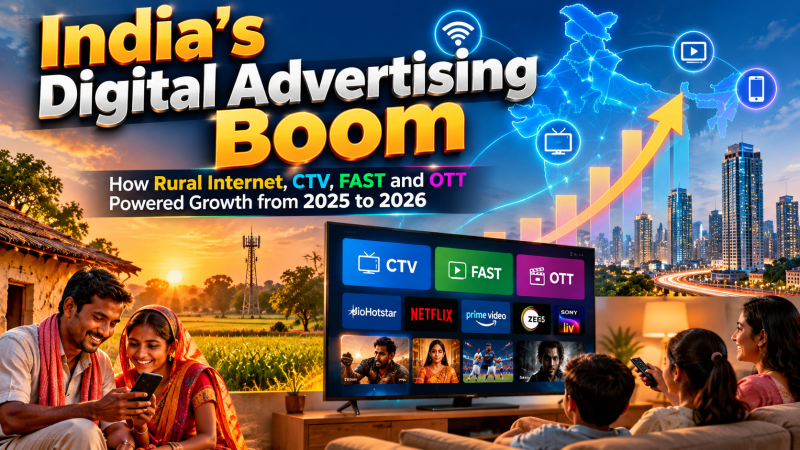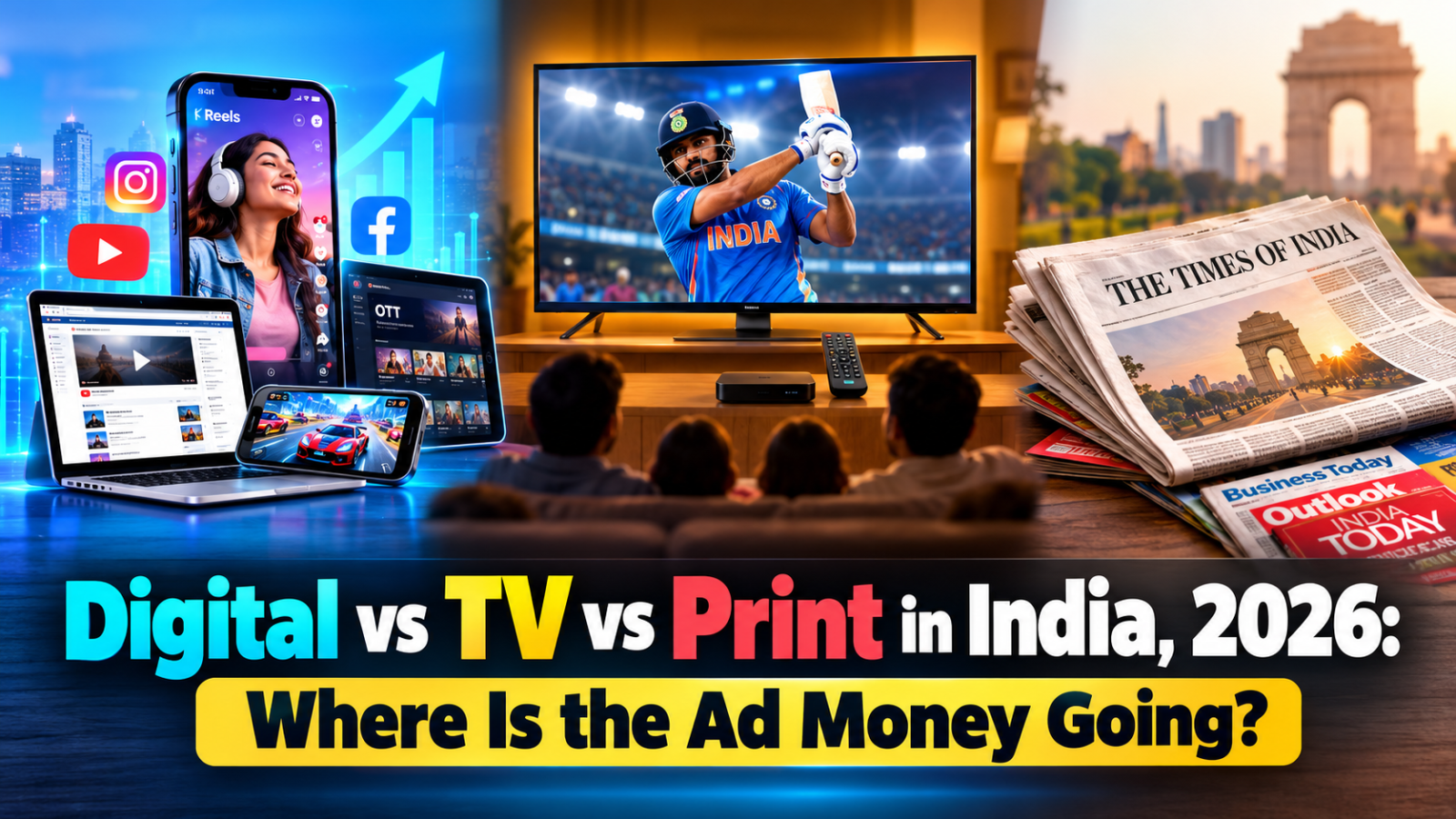
Ask a media planner where the next rupee should go, and you will hear “digital” far more often than you did a few years ago. But how big is the gap really? And what does each side cost? Here are the 2026 numbers in plain language.
The big picture
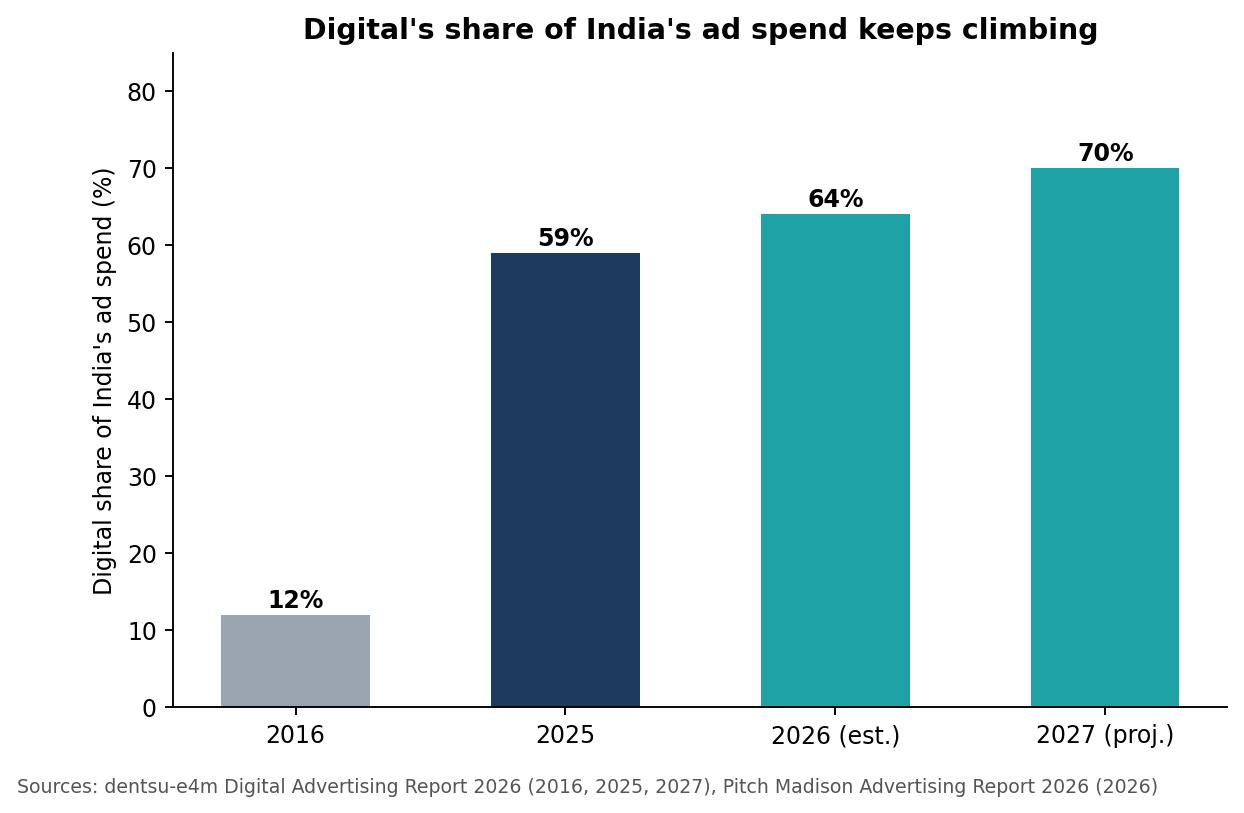
Digital reached ₹71,621 crore by the end of 2025, about 59% of all ad spend in India, according to the dentsu-e4m report. Back in 2016 that share was only 12%. The Madison report expects the total market to hit about ₹1.74 lakh crore in 2026, with digital at roughly 64%.
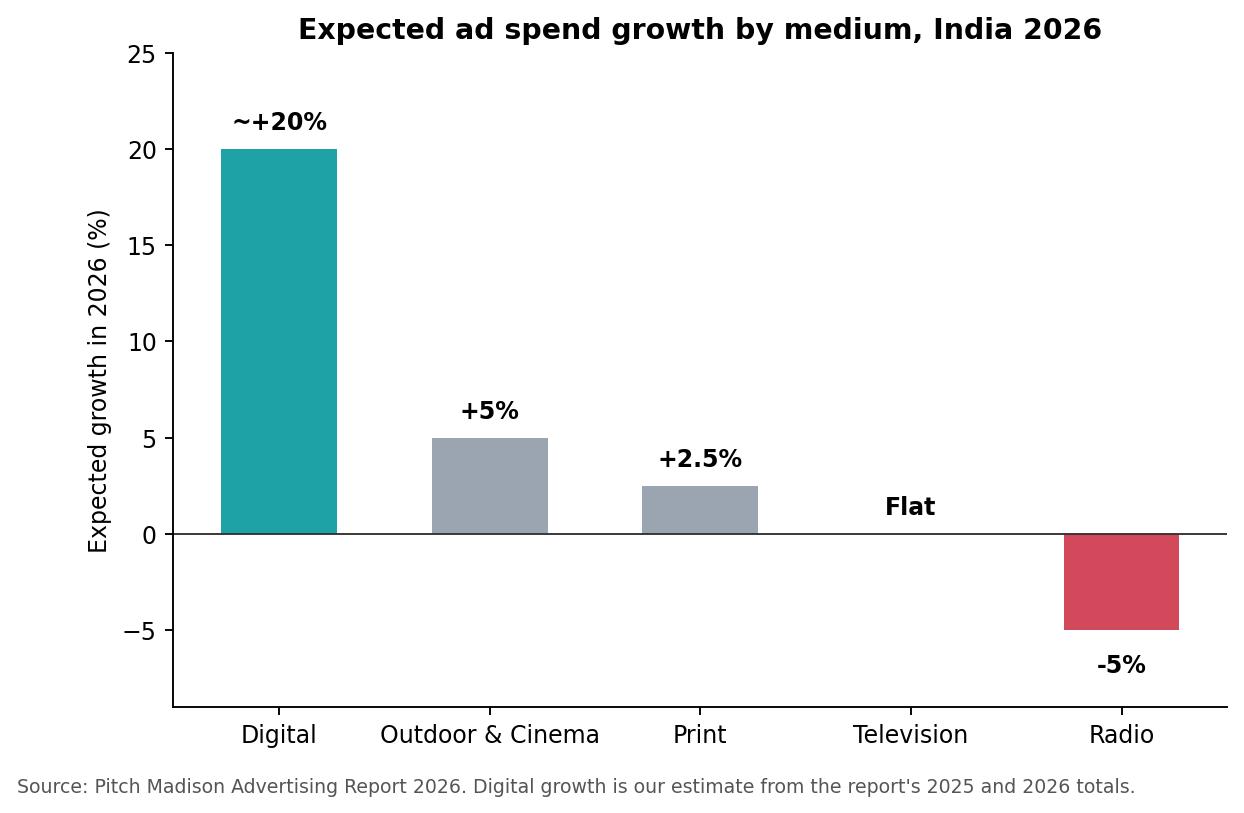
Traditional media is not collapsing, but it is slow. Madison expects print to grow 2.5%, cinema and outdoor around 5%, and TV to stay flat, while radio falls 5%. Other forecasts are tougher on TV. WPP Media expects total TV ad revenue to fall 6.8% in 2026. TAM data also shows news TV ad volumes down 7% from January to July. The numbers differ by report, but they all point the same way.
Print still has real weight. It brought in ₹20,866 crore in 2025. It remains strong for regional and trust-led campaigns. So this is not an either/or choice.
What digital costs: CPM, CPC, CPV and CPCV
A quick refresher. CPM is the price per 1,000 impressions. CPC is the price per click. CPV is the price per video view. CPCV is the price per completed video view.
Banner and display CPM. Prices vary a lot by site and audience. Premium niche publishers can ask ₹300 to ₹800 per thousand impressions for standard display. On Instagram, CPMs run roughly ₹45 to ₹350. India is also cheap compared with the West. Paid social CPMs here are 65–70% lower than US benchmarks.
CPC. Instagram clicks cost ₹6 to ₹55, and most D2C brands see ₹8 to ₹25. Regional-language creatives in smaller cities often bring that down to ₹4–12.
CPV. YouTube views in India typically cost ₹0.50 to ₹3.00. Targeting, creative quality and season all move this number.
CPCV. Here you pay only when someone watches the full ad. Hotstar, for example, sells video ads on either CPM or CPCV. Here is a simple worked example. Take a CTV rate of ₹243 per 1,000 views. If 95% of viewers finish the ad (a figure sellers often quote), you pay about ₹0.26 per completed view. That is our own calculation, so treat it as a guide, not a quote.
TV works differently. You buy spots, not clicks. With linear TV you pay whether viewers care about the ad or not. Digital lets you pay closer to the result you want.
CTV, OTT and FAST: TV is moving online
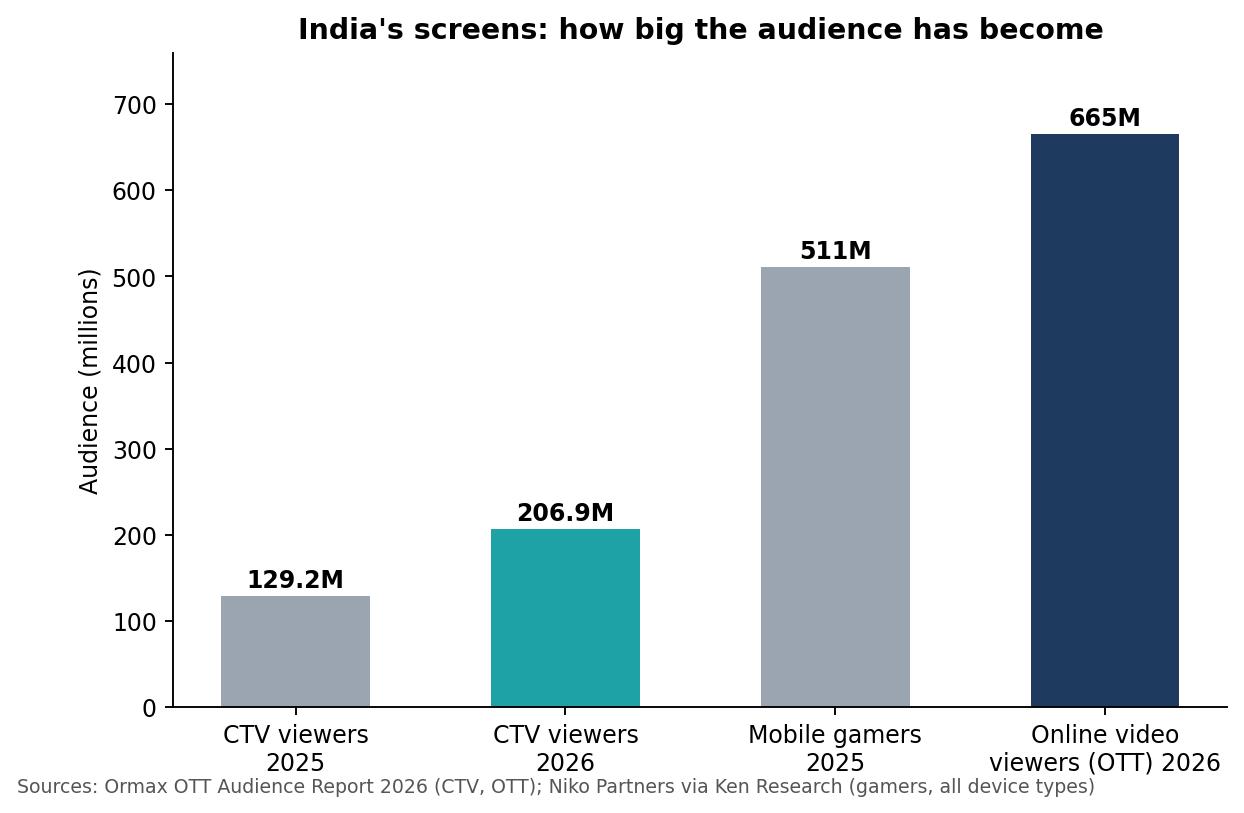
This is the most exciting part of 2026. India’s Connected TV audience jumped from 129.2 million to 206.9 million in a single year. That audience sits across 62 to 65 million households, watching about 2.9 hours a day. About 27% of CTV homes are cord-cutters, so a linear TV ad never reaches them.
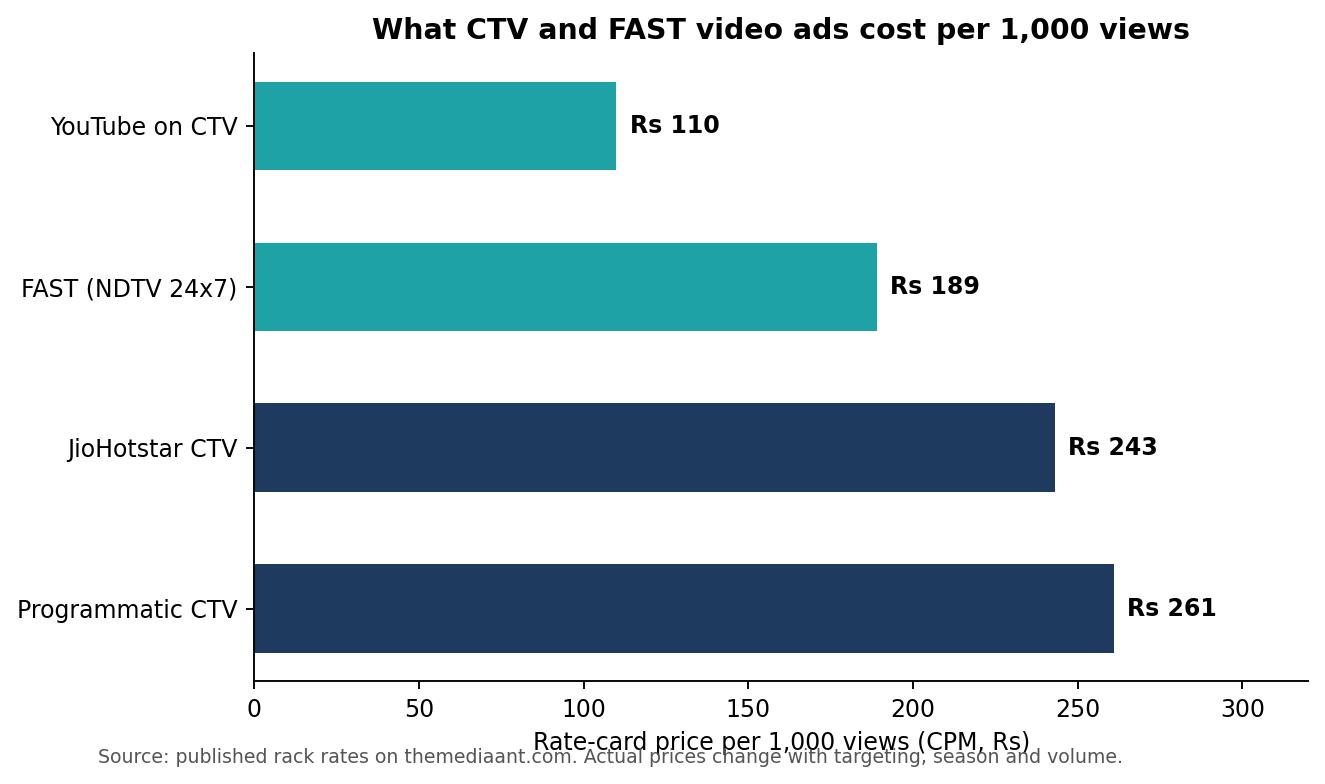
What does it cost? Published rate cards sit between ₹110 and ₹261 per 1,000 views. YouTube on CTV is the cheapest, followed by FAST on NDTV, JioHotstar, and programmatic CTV. Premium shows cost much more. One celebrity talk show is reportedly asking up to ₹2,200 CPM.
FAST means free, ad-supported streaming channels. They are still young but growing quickly. One in five CTV viewers already watches FAST for close to 50 minutes a day. These viewers also spend more time on CTV overall, about 3.4 hours daily. On the OTT side, paid subscriptions grew 16% this year.
There is a catch. Ad spend is still behind the audience. A brand running across several streaming platforms may face four different definitions of a “view.” Until measurement gets simpler, plan CTV carefully.
India’s phone-first audience
The phone is now the main screen for millions of people. Estimates put smartphone users above 820 million. About 45% of the population now watches online video, up from 41% last year.
Gaming tells the same story. India had around 511 million gamers in 2025, and the number is expected to pass 550 million in 2026. Over 94% of them play on smartphones. Language matters too. Regional-language content has grown from 47% to 52% of the market. Online video alone is expected to take about 29% of digital ad spend.
What this means for your brand
Start with your goal, not the channel.
- Awareness at scale: Use YouTube, CTV and FAST for reach, and keep TV for mass-market moments.
- Sales and leads: Use CPC and CPCV buying, where you pay for action.
- Smaller cities: Run regional-language video on mobile. It is cheaper and works.
- Trust and local reach: Keep print in the mix, especially in regional markets.
Whatever you pick, ask for clear reporting on views and completions. Money follows measurement.
At ManziNetworks, we help brands plan this mix every day. If you want to know where your next campaign should go, get in touch.
ManziNetworks Media runs CTV, FAST, OTT and digital campaigns for brands across India, the GCC and South East Asia, since 2009.